Buying cotton tote bags wholesale can be a smart decision for retailers, corporate gifting companies, event organisers, promotional agencies and businesses looking for reusable packaging. Ordering in bulk can reduce the cost per bag, simplify inventory planning and provide a consistent product for your customers.
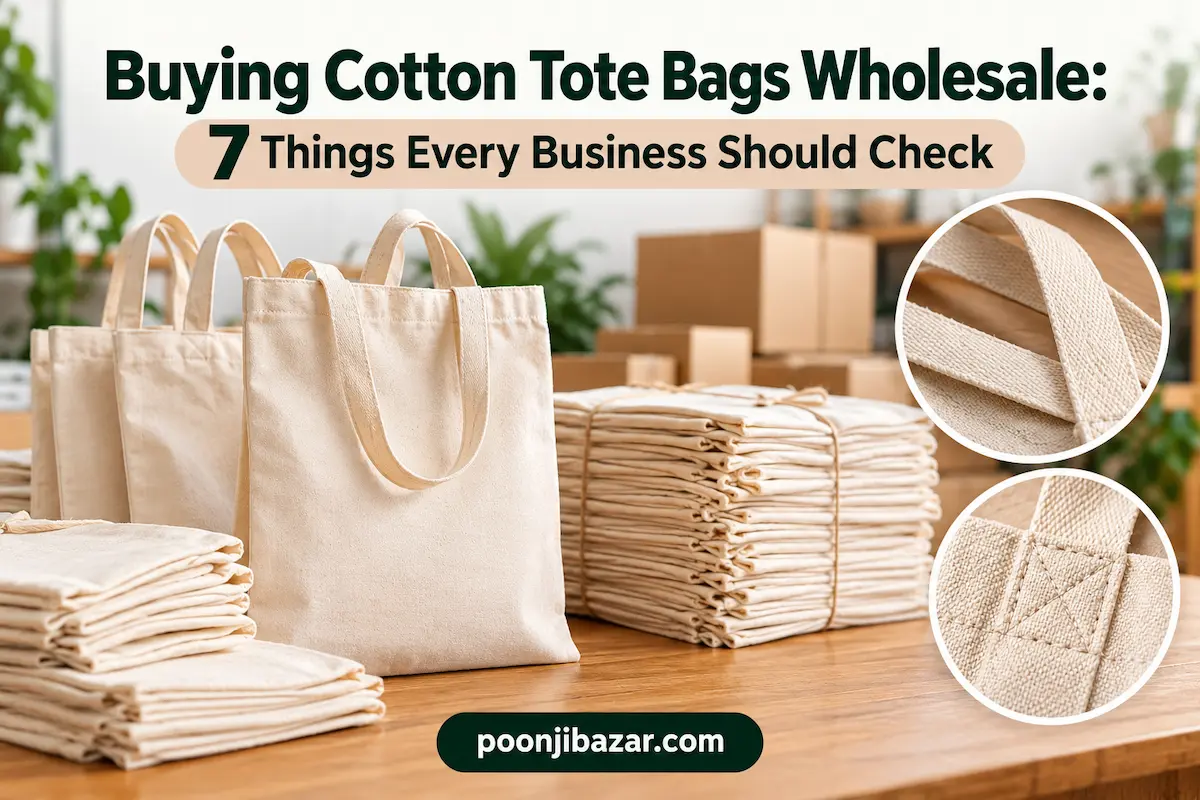
However, not all cotton tote bags are made to the same standard. Two bags may look similar in photographs but differ significantly in fabric quality, stitching, handle strength and overall durability. Choosing the cheapest option without checking these details can lead to customer complaints, damaged merchandise and unnecessary replacement costs.
Whether you need plain cotton bags for retail packaging, branded bags for corporate events or reusable shopping bags for your business, understanding the specifications before placing an order is essential.
In this guide, we explain seven important things every business should check before buying cotton tote bags in bulk.
7 Things to Check Before Buying Cotton Tote Bags Wholesale
Use this checklist before placing your next bulk order.
- 1. Fabric Quality Check cotton composition, GSM and durability.
- 2. Bag Dimensions Confirm width, height and gusset size.
- 3. Handles & Stitching Inspect handle length, seams and reinforcement.
- 4. Wholesale Pricing Compare specifications and total landed cost.
- 5. Printing & Customisation Confirm logo placement, colours and print quality.
- 6. Supplier Reliability Check samples, delivery timelines and quality control.
- 7. Order Quantity Match bulk purchases to demand and storage capacity.
1. Check the Cotton Fabric Quality and Thickness
Fabric quality is one of the first things to evaluate when buying wholesale cotton tote bags. It affects the bag’s appearance, durability, feel and suitability for different applications.
One useful specification to ask about is GSM, which stands for grams per square metre. It indicates the weight of the fabric and helps buyers compare different materials. However, GSM alone does not guarantee quality because weave, yarn quality and construction also matter.
Which cotton fabric weight should you choose?
The following ranges are general buying guidelines. Actual performance depends on the fabric and bag construction.
- Lightweight cotton: Suitable for promotional giveaways, lightweight merchandise and applications where affordability is the main consideration.
- Medium-weight cotton: A practical option for everyday shopping bags, retail packaging, exhibitions and general-purpose promotional bags.
- Heavy cotton or canvas: Better suited to premium retail packaging, corporate gifts and applications requiring a more substantial feel.
Ask your supplier to specify the fabric weight and composition rather than relying on descriptions such as “premium cotton” or “heavy-duty fabric.”
If you plan to use the bags repeatedly, request a sample and check how the fabric feels, how it holds its shape and whether it is sufficiently opaque for your intended use.
Business tip: Choose fabric according to the job the bag must perform. A lightweight giveaway bag and a reusable shopping bag do not necessarily need the same specifications.
2. Verify the Bag Size and Dimensions
The right bag size depends on what you intend to carry, pack or distribute. A bag that looks large in a product photograph may be too small for your merchandise.
Before ordering cotton tote bags wholesale, confirm the finished dimensions in writing.
For example, a common tote bag specification is:
- Bag width: 14 inches
- Bag height: 16 inches
- Handle length: 24 inches
These dimensions are an example, not a universal standard. Different sizes are appropriate for different businesses and products.
Match the bag size to its intended use
Retail shops: Clothing stores, gift shops and boutiques should select dimensions that comfortably accommodate their typical products.
Corporate events: Conference organisers may need enough room for documents, notebooks, water bottles and promotional materials.
Exhibitions and trade shows: Bags should be easy to carry while providing sufficient space for brochures, catalogues and product samples.
Gift packaging: Businesses distributing festive hampers or employee gifts may need wider bags or additional depth.
Remember that width and height do not tell the whole story. A flat tote bag and a tote bag with a bottom gusset can have the same width and height but very different usable capacities.
If you need to carry bulky products, ask whether the supplier can provide a gusseted design.
3. Examine Handle Length, Stitching and Load-Bearing Strength
Handles are an important part of a cotton tote bag because they affect comfort, usability and durability.
A bag may have good fabric but still fail if its handles are poorly attached. This is especially important for businesses distributing bags that will carry books, clothing, groceries or other merchandise.
What should you inspect?
Check these construction details before approving a bulk order:
- Handle length: Short handles are suitable for hand carrying, while longer handles make shoulder carrying easier.
- Handle attachment: Look for secure stitching where each handle joins the bag body.
- Seam finishing: Check for loose threads, uneven seams and visible gaps.
- Reinforcement: Bags intended for heavier loads may benefit from reinforced handle attachment and stronger seams.
- Comfort: Handles should be appropriate for the expected load and carrying duration.
A box stitch or cross-stitch reinforcement can help distribute stress at handle attachment points, although the right construction depends on the fabric, handle design and intended load.
Do not assume that every cotton bag can safely carry the same weight. Ask the supplier about the intended load capacity and, where relevant, how it has been tested.
For a bulk purchase, test a representative sample under realistic conditions instead of judging strength solely by appearance.
4. Compare Wholesale Prices on an Equal Basis
Price is naturally an important consideration when buying cotton tote bags wholesale. However, comparing prices without comparing specifications can lead to the wrong purchasing decision.
One supplier may quote a lower price for a smaller bag made from lighter fabric, while another may offer a larger bag with reinforced handles. The two quotations are not directly comparable.
What determines the wholesale price?
Several factors influence the final cost per bag:
- Fabric type and weight
- Finished bag dimensions
- Handle material and length
- Stitching and construction
- Plain or printed finish
- Number of printing colours
- Total order quantity
- Packaging, shipping and applicable taxes
Larger orders may qualify for lower unit prices, but the savings depend on the supplier’s production costs, available stock and order specifications.
Calculate the total landed cost
Before selecting a supplier, calculate the complete cost of receiving the bags at your premises.
Total landed cost per bag = Total order cost ÷ Number of usable bags received
Include the applicable bag price, printing charges, packaging, transportation and taxes in your calculation. Also account for any defective units or expected wastage.
For example, a quotation of ₹30 per bag may appear more attractive than one of ₹33. But if the cheaper order has higher delivery charges or a greater defect rate, its actual cost advantage may disappear.
Request written quotations for the same size, fabric specification, handle design, printing requirements and quantity. This makes it much easier to compare suppliers fairly.
5. Check Printing and Customisation Options
For many businesses, cotton tote bags are more than packaging. They are also an opportunity to display a logo, communicate a brand message or create a memorable gift.
Before ordering customised cotton tote bags, confirm which printing options are available and whether they suit your artwork.
Common customisation options
Screen printing: Often a practical choice for bulk orders with relatively simple artwork and a limited number of colours. Setup requirements and cost depend on the design and production process.
Digital printing: Can be useful for detailed, multicolour artwork, depending on the fabric and printing technology.
Heat-transfer printing: Suitable for certain logos and complex designs, but durability and finish depend on the transfer material and application process.
Embroidery: Creates a textured, stitched design and can suit premium corporate gifts or branded merchandise.
Not every printing method is suitable for every cotton fabric. Ask the supplier to recommend a process based on your artwork, quantity, budget and expected use.
Approve the design before bulk production
Confirm the following details before giving final approval:
- Logo size and placement
- Artwork dimensions and file requirements
- Number of colours
- Print area
- Colour matching requirements
- Expected finish and durability
If branding is important to your business, request a physical printed sample where practical. A digital mock-up is useful for layout approval, but it cannot fully demonstrate the feel of the fabric or the actual printed finish.
For repeat orders, retain the approved artwork and sample specifications so subsequent batches can be compared with the original.
6. Evaluate the Supplier’s Reliability and Quality Control
Choosing the right cotton tote bag supplier is just as important as choosing the right bag.
A reliable supplier should understand your requirements, explain product specifications clearly and communicate honestly about pricing, stock and delivery.
Before placing a large order, consider the following checks.
Ask for a product sample
A sample lets you examine the actual fabric, dimensions, handle construction, stitching and overall finish. Check whether the sample matches the specifications in the quotation. If the order will include printing, inspect the printed version as well.
Confirm availability and production timelines
Ask whether the bags are ready stock or need to be manufactured. Custom printing, special dimensions and non-standard colours may require additional time. If the bags are required for a trade fair, corporate event, festive campaign or product launch, allow enough time for sample approval, production, dispatch and delivery.
Request a clear quotation
Your quotation should identify the product, quantity, dimensions, fabric specification, customisation requirements, price, taxes, shipping charges and expected dispatch date.
For larger orders, also clarify the supplier’s policy for defective or incorrect items.
Check consistency across batches
If you expect to reorder regularly, ask how the supplier maintains consistency in fabric, dimensions, stitching and colour. This matters for retailers and businesses that need their packaging to look the same across multiple locations or successive orders.
A supplier who can explain the product clearly and provide written specifications is generally easier to work with than one who offers only a low price without meaningful product details.
7. Calculate Your Order Quantity and Plan Inventory
Buying in bulk can reduce the unit cost, but placing an unnecessarily large order can tie up money and occupy valuable storage space. The right order quantity depends on your expected demand, available storage, cash flow and the time required to replenish stock.
Estimate your monthly requirement
Start by calculating how many bags your business typically uses.
For example, if your shop distributes 25 bags per working day and operates for 24 days each month:
25 bags × 24 days = 600 bags per month.
A two-month stock requirement would therefore be approximately 1,200 bags, before allowing for changes in demand or additional safety stock.
This is only an illustration. Your actual requirement will depend on your business and seasonal sales.
Compare different order quantities
Ask your supplier for quotations at several quantities, such as 100, 500 and 1,000 bags, where those quantities are available. Compare the price difference against the additional investment and storage required.
Before ordering, consider:
- Average monthly consumption
- Expected seasonal demand
- Storage space
- Cash flow
- Supplier lead time
- Minimum order quantities
- Cost of placing repeat orders
If your business uses bags regularly, a planned replenishment schedule can help you avoid emergency purchases. However, it is usually better to place a manageable order than to buy excess stock solely to secure a small discount.
Why Cotton Tote Bags Are Useful for Businesses
Cotton tote bags serve a variety of practical purposes across retail, hospitality, events and corporate gifting.
Reusable retail packaging
Clothing stores, bookstores, gift shops and lifestyle retailers can use cotton tote bags to package purchases. A well-made bag may also be reused by the customer, extending the visibility of a brand beyond the original transaction.
Corporate gifting and employee kits
Businesses can use tote bags to carry notebooks, documents, welcome kits and branded merchandise. Custom printing can help maintain a consistent visual identity across events and employee programmes.
Exhibitions and promotional campaigns
Reusable bags are convenient for carrying brochures, samples and other event materials. The size, weight and handle length should be selected according to what attendees are expected to carry.
Packaging for small businesses
Online sellers and local retailers can use cotton bags for selected products, gift packaging or special campaigns. The appropriate bag depends on product dimensions, weight and the desired presentation.
Cotton is a reusable natural fibre, but a bag’s overall environmental impact depends on how it is manufactured, transported and reused. Businesses making sustainability claims should ensure those claims are supported by the relevant product information rather than assuming that every cotton bag is automatically the most sustainable option.
Wholesale Cotton Tote Bag Buying Checklist
Before confirming your order, use this checklist to ensure that the important specifications have been covered.
- Fabric composition and GSM confirmed
- Finished bag dimensions confirmed
- Handle length and construction checked
- Stitching and intended load capacity reviewed
- Plain or printed finish specified
- Logo artwork and placement approved
- Sample inspected, where appropriate
- Unit price and total landed cost calculated
- Order quantity matched to expected demand
- Dispatch date and delivery arrangements confirmed
- Defective-item and replacement terms clarified
Keeping these details in writing reduces misunderstandings and makes future reorders easier.
Frequently Asked Questions
1. What should I check before buying cotton tote bags wholesale?
Check the fabric quality, GSM, dimensions, handle length, stitching, price, printing options, supplier reliability and order quantity. These factors help you select bags suited to your intended use and budget.
2. Which size is suitable for wholesale cotton tote bags?
The right size depends on the products you need to carry. A 14 × 16-inch bag can be a useful option for many retail and promotional applications, while larger bags or gusseted designs may be more appropriate for bulky products.
3. Are plain cotton tote bags cheaper than printed bags?
Plain bags generally cost less because they do not require printing or embroidery. The additional cost of customisation depends on the printing method, artwork, number of colours and order quantity.
4. Is buying cotton tote bags in bulk more economical?
It can be. Bulk orders may reduce the per-bag cost, particularly when production and printing setup costs are spread across more units. However, buyers should also consider shipping, taxes, storage and the risk of excess inventory.
5. Can cotton tote bags be customised with a business logo?
Yes, depending on the supplier’s available options. Screen printing, digital printing, heat transfer and embroidery may be suitable for different designs. Confirm the available methods and approve the artwork before production.
6. How can I check whether a cotton tote bag is durable?
Inspect the fabric, side seams and handle attachment points. Check the finish for loose threads and uneven stitching, and test a sample under realistic carrying conditions. Ask the supplier to confirm the intended load capacity.
7. Who should consider buying cotton tote bags wholesale?
Retailers, corporate gifting companies, event organisers, promotional agencies, exhibition exhibitors and small businesses can all benefit from buying cotton tote bags in bulk when they have predictable demand.
Final Thoughts
Buying cotton tote bags wholesale is not simply about finding the lowest price per piece. It is about selecting a bag that matches your business requirements, offers appropriate durability and provides good value over its useful life.
Start by identifying how the bags will be used. Then compare fabric specifications, dimensions, handles, stitching, printing requirements and total landed cost. Inspect a sample where appropriate, confirm delivery timelines and choose an order quantity that matches your actual demand.
A little preparation before placing a bulk order can help you avoid costly mistakes and establish a more dependable packaging supply.
Looking for cotton tote bags for your business? Explore the cotton tote bag options at No Plastic Shop and choose a suitable style for retail packaging, corporate gifting, promotional activities or everyday shopping. For bulk requirements, confirm the available sizes, pack quantities and customisation options before placing your order.